

Over the last year, I have been working with faculty at UC San Diego and the Sustainable Development Goal Policy Initiative (SDGPI) to lead the development of a report on how climate change is impacting the economy of California. UC San Diego’s School of Global Policy and Strategy (GPS) professors Gordon McCord and Teevrat Garg are Lead Authors of the upcoming Climate Impacts to the Economy report. I began working on this report in January of 2025 as a part-time graduate student researcher and continued on full-time after graduating from GPS Master of Public Policy program in June 2025.
California’s Fifth Climate Change Assessment
This report is one of 50 reports that will be released as part of California’s Fifth Climate Change Assessment, organized by the California’s Governor’s Office of Land Use and Climate Innovation (LCI). The expected release date of the entire Fifth Assessment is September 2026. The Fifth Assessment will be California’s most ambitious climate science and policy effort to date, composed of technical, regional, and statewide reports. Other topical reports within the Fifth Assessment include: Racial Equity and Climate Justice, Climate Induced Human Displacement and Migration, Tribal and Indigenous Communities, Climate Financing and Insurance, and Public Health. Together, the Fifth Assessment will provide the latest research to help California communities and the State respond to growing climate impacts. Previous California Climate Change Assessments were published in 2006, 2009, 2012, and 2018.
My role in the Development of the Climate Impacts to the Economy Topical Report
Throughout the development of this report, I have utilized the valuable quantitative, econometric, and data analysis skills developed through my coursework at GPS. To produce this report, we conducted county-level analyses that integrate climate projections, demographic, and economic data to estimate economic climate damages on mortality, labor hours worked, and energy consumption and demand. This analysis was done in a combination of Python and R. The data utilized for the report includes historical and projected temperature data derived from Climate Model Intercomparison Program Phase 6 Localized Constructed Analogs (CMIP6-LOCA2) Global Climate Models. In addition, our analysis incorporates damage functions and datasets used in the Fifth National Climate Assessment, including the US EPA’s Framework for Evaluating Damages and Impacts (FrEDI). FrEDI provides empirically grounded damage functions based on peer-reviewed research, and enabled us to estimate climate-related impacts across multiple sectors of the economy.
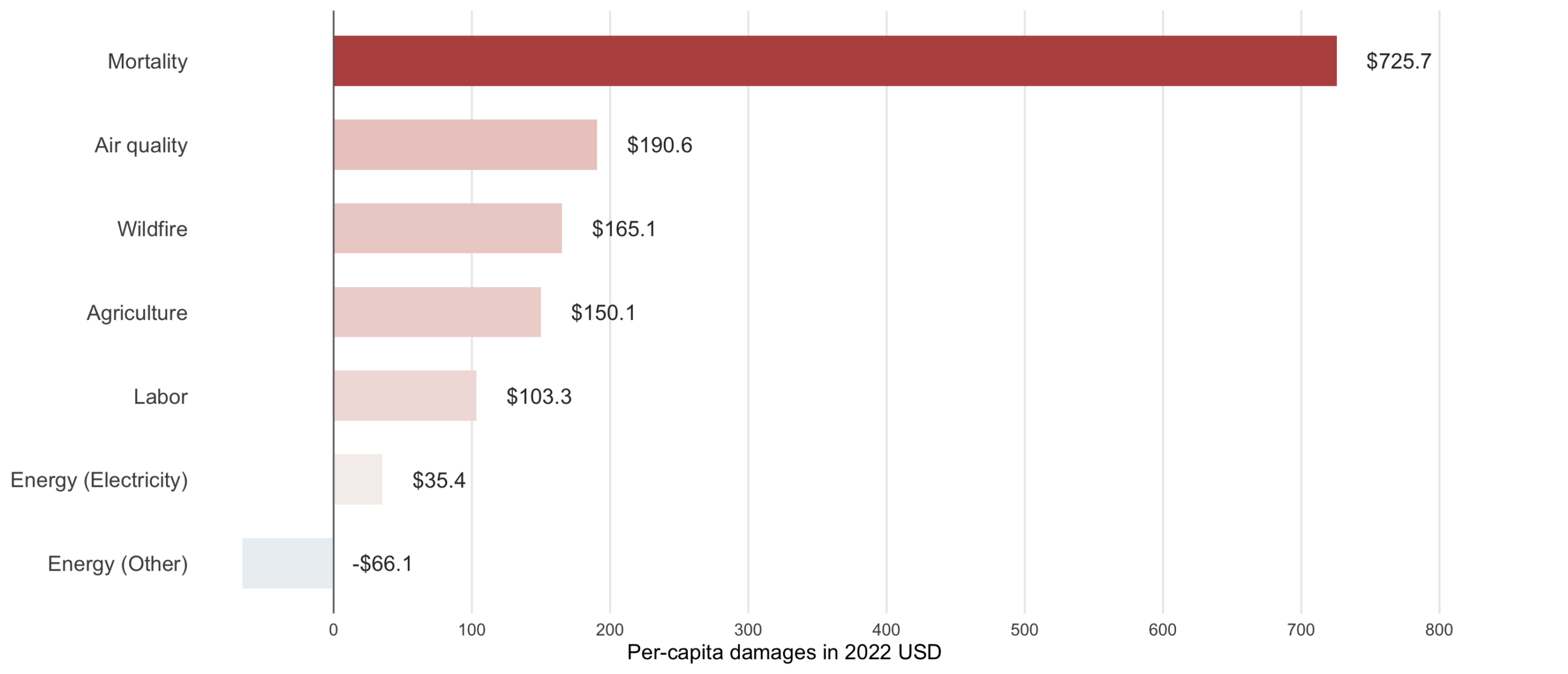
In addition to analytical work, I have supported the broader coordination efforts required for a large, interdisciplinary assessment, as well as content creation for the report itself. As a Project Manager I have tracked milestones, met internal deadlines, assembled administrative deliverables, and organized stakeholder engagement between academic advisors, state agency personnel, other teams on the Fifth Assessment, and the public. As a Contributing Author I have conducted extensive reviews of the latest available peer-reviewed literature to identify, synthesize, and elevate key findings within the report. I have drafted more than 150 pages of content and led the development of sections examining how climate change affects California’s social, built, and natural systems.
This work has significantly strengthened my understanding of the economic dimensions of climate change and the methodological challenges involved in translating climate projections into estimates of real-world economic risks and policy-relevant impacts. Leveraging this experience and the opportunity to collaborate with leading environmental economists and the broader Fifth Assessment research community has provided invaluable professional and intellectual development.
Federal Climate Assessments on Pause
California’s Fifth Assessment contributes to national efforts such as the National Climate Assessment series, mandated by Congress through the Global Change Research Act of 1990, to integrate and disseminate research on global climate change trends and impacts. While the most recent National Climate Assessment was published in 2023, the development of future national assessments have been discontinued as of July 2025. With future federal assessments now paused, California’s Fifth Assessment becomes even more important as a source of credible, policy-relevant climate information to guide planning, investment, and risk management across the state.