Report spells out the balancing act local leaders must perform to make over the way the region powers its homes, roads and businesses . . .
Climate Action at the Local Level: Existing Evidence, Gaps and Insights
The success of climate policy in the United States largely depends on how state and local governments design and implement policies. SDG Policy Initiative (SDGPI) faculty and graduate student researchers are partnering with J-PAL North America and jurisdictions across the U.S. to identify priority climate actions for policy evaluation. Beginning with a partnership with the County of San Diego, the SDGPI team analyzed the County’s Climate Action Plan (CAP) by conducting a literature review that maps the County’s climate actions to rigorous impact evaluations. This literature review for each climate action intends to make policymakers more aware of existing academic studies to inform the implementation of climate actions and identify priority areas for new studies to fill knowledge gaps. The SDGPI team is also supporting the County and other jurisdictions across the U.S. by designing randomized impact evaluations of key programs that are intended to reduce greenhouse gas emissions.
Evidence Review for the County of San Diego’s Climate Action Plan
State and local jurisdictions bear much of the responsibility for implementing climate legislation, including to incentivize consumers and businesses to produce and use more renewable energy, drive more electric vehicles and adopt other sustainability measures. However, as SDGPI researchers have argued, in many cases there is little evidence on which climate policies are actually effective, and so jurisdictions must adopt an attitude of experimentation and evaluation.
In order to facilitate evidence-based climate policies, SDGPI researchers are developing a comprehensive literature review that highlights key findings from impact evaluations of policies and programs designed to reduce greenhouse gas emissions. This synthesis helps policymakers understand the evidence base for which climate actions are more effective and which may not have strong evidence of impact. It also helps identify climate actions suitable for evaluation and informs their understanding of the effectiveness of interventions outlined in their Climate Action Plans. These CAPs, typically adopted at the local level, are comprehensive policy documents that guide local decision-making to reduce greenhouse gas emissions in various sectors.
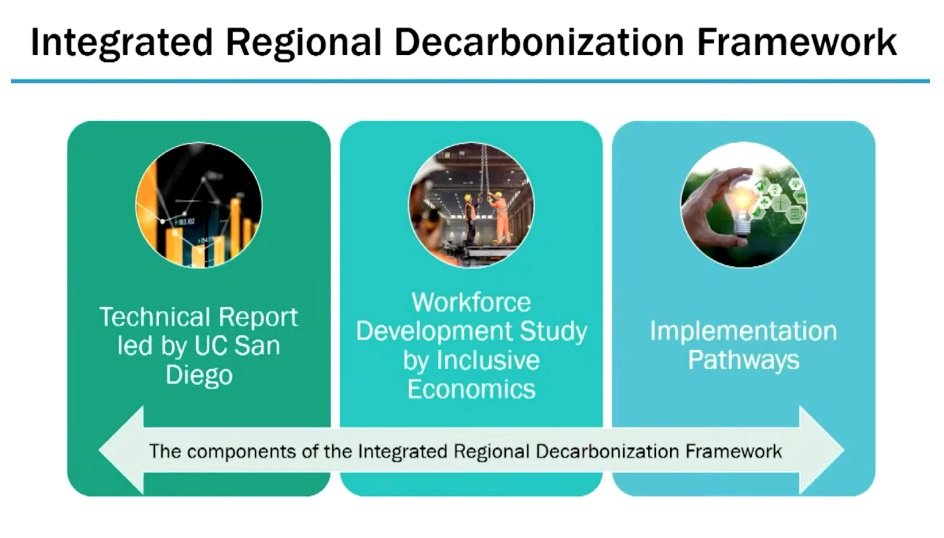
Our work, supported by the Abdul Latif Jameel Poverty Action Lab (J-PAL) North America, builds on recent research co-authored by GPS professors Gordon McCord and Teevrat Garg that highlights the importance of evaluating decarbonization programs to enhance cost-effectiveness and impact. The project also builds on SDGPI’s ongoing partnership with the County of San Diego, including collaboration on the County’s Regional Decarbonization Framework.
SDGPI researchers are mapping existing rigorous evidence to the County’s climate policies across the five County CAP sectors: Built Environment & Transportation, Energy, Solid Waste, Water & Wastewater, and Agriculture & Conservation. To make sure that the studies are relevant to the current U.S. context, the literature review included studies published since 2000 in developed countries. Studies’ research design was a core focus of the literature review methodology, with an emphasis on randomized evaluations, which provide the gold standard evidence of a program’s impact. These evaluations offer insights into the effectiveness of behavioral interventions, answering questions such as: Do EV purchase incentives encourage EV adoption among populations that wouldn’t have bought one absent the program? Do monetary rewards for contractors increase the effectiveness of energy efficiency installations? What kinds of financial incentives might help farmers transition to climate-friendly farming techniques?
Findings from the literature review are already helping policymakers better target incentives, identify distributional impacts of policies, and ensure programs have intended outcomes. At the same time, gaps in the evidence base highlight opportunities for jurisdictions to evaluate their own programs and contribute to a growing body of knowledge – supporting the SDG Policy Initiative’s goal of promoting evidence-based policies in the context of clean energy and climate-related Sustainable Development Goals (SDGs).
SDGPI also provides support to policymakers in effectively evaluating high-priority programs. Researchers are currently designing randomized control trials (RCTs) to help San Diego County and other jurisdictions assess whether programs mandated in its CAP are achieving their intended emissions reductions. RCTs are considered the gold standard for evaluating the impact of these programs, due to their randomized design that allows researchers to best attribute observed outcomes to the intervention being studied. Findings from these studies will not only strengthen the evidence base for local decision-making, but also generate insights that build capacity to meet climate targets nationwide. This initiative is part of the work of J-PAL’s Economics of Decarbonization Working Group, which seeks to develop a coordinated experimental evidence base to inform carbon mitigation efforts in the U.S. and other OECD countries.

Caption: Staff and researchers from the County of San Diego, UC San Diego School of Global Policy & Strategy, and J-PAL North America gathered for a 2-day training at the County’s headquarters. Photo Credit: Erin Graeber, Communications Lead for J-PAL North America
Leveraging Randomized Evaluation for Local Climate Action
SDGPI researchers participated in a two-day training that introduced San Diego County staff to randomized evaluation design strategies and shared findings from the Climate Action Plan literature review. The training culminated in a workshop to identify priority programs for the County to pursue randomized evaluation, based on the findings of the literature review. More information on the evidence review for the County and insights from the two-day training can be found in a recent blog post.
Caption: Staff and researchers from the County of San Diego, UC San Diego School of Global Policy & Strategy, and J-PAL North America gathered for a 2-day training at the County’s headquarters. Photo Credit: Erin Graeber, Communications Lead for J-PAL North America
The literature review that began through SDGPI’s partnership with the County of San Diego is growing into a widely applicable tool designed to scale knowledge and support research efforts nationwide. SDG Policy Initiative researchers are now working with jurisdictions across the country – including those participating in the J-PAL North America Climate Action Learning Lab – to identify and advance high-impact, equitable decarbonization policies by supporting the evidence review and generation process and collaborating with other scholars in the field. This work will culminate in a white paper summarizing key insights and actionable evidence, helping jurisdictions align climate actions with existing research and identify actions fruitful for new impact evaluations. Together, these products advance SDGPI’s mission: fostering stronger collaboration between researchers and policymakers to promote evidence-based policies in support of the SDGs and global climate goals.
Latest
SDGPI and the Sustainable Development Solutions network continue to partner on project blazing a trail for regional decarbonization efforts. . . .
Aug 2, 2022
SDGPI Director Gordon McCord joined Globus, a podcast from the Sustainable Development Solutions Network Youth USA to discuss data as the future of SDG work, the necessity to localize SDG solutions, and how to bridge questions of communication. . . .
May 7, 2022
Switching San Diego off fossil fuels onto green energy will require careful efforts to preserve and create high quality jobs, experts told the San Diego County Board of Supervisors Wednesday. . . .
Mar 17, 2022
San Diego County supervisors got a glimpse of a more climate-friendly future when briefed on a regional plan designed to de-carbonize the county. The idea driving the effort is to reach a net carbon neutral goal, essentially only releasing as much carbon into the air, that can be balanced . . .