California’s Fifth Climate Change Assessment: Climate Impacts to the Economy

- Climate change is projected to continue imposing large and growing economic costs on California, with the largest monetized damages arising from premature mortality.

Project overview

This report is a core component of California’s Fifth Climate Change Assessment, led by researchers at the UC San Diego School of Global Policy and Strategy. It translates cutting-edge climate research into clear economic terms, helping state and local leaders understand the financial stakes of inaction and the critical need for cost-effective adaptation.

This report examines the direct and indirect economic effects of climate change across key sectors of California’s economy, synthesizing evidence from peer-reviewed academic research, government agency reports, and analyses by private and nonprofit organizations. The analysis is organized into three interconnected systems that collectively encompass California’s economic landscape:

  • The Social Systems section focuses on human-centered economic activities, analyzing impacts on public health costs, labor productivity and workforce dynamics, educational infrastructure and outcomes, and government operations and fiscal capacity. 
  • The Built Systems section addresses critical infrastructure that underpins economic activity, encompassing real estate markets and property insurance sectors responding to natural hazard risks, transportation networks, and water and energy systems. 
  • The Natural Systems section examines sectors heavily dependent on natural resources, including agriculture, fisheries, forestry, and tourism, industries that face direct exposure to changing temperature, precipitation, and fire patterns.

Key Findings

Massive Economic Toll

Historical events are already costing billions; for example, wildfires between 2017 and 2021 caused over $117.4 billion in average annual economic losses.

Uneven Regional Impacts

By 2100, electricity costs for cooling in the Central Valley and Southern California could be four times higher than in North Coast counties.

The Mortality Burden

Excess mortality is projected to account for approximately 70% of all climate-related economic damages by the end of the century.

Climate Change is Already Imposing Significant Costs

  • Seven major heat events between 2013 and 2022 resulted in $7.7 billion in damages.
  • The 2020-2022 drought caused an estimated $3 billion in agricultural losses in 2022 alone.
  • California currently faces $1.7 billion in annual flood damages, with approximately 230,000 residential properties statewide at substantial flood risk.
Heat Damages
$ 0 B
Wildfire Losses
$ 0 B
Drought Impact
$ 0 B
Flood Risk
$ 0 B

Selected Economic Damages

Projected Per‑Capita Economic Losses from Climate Change

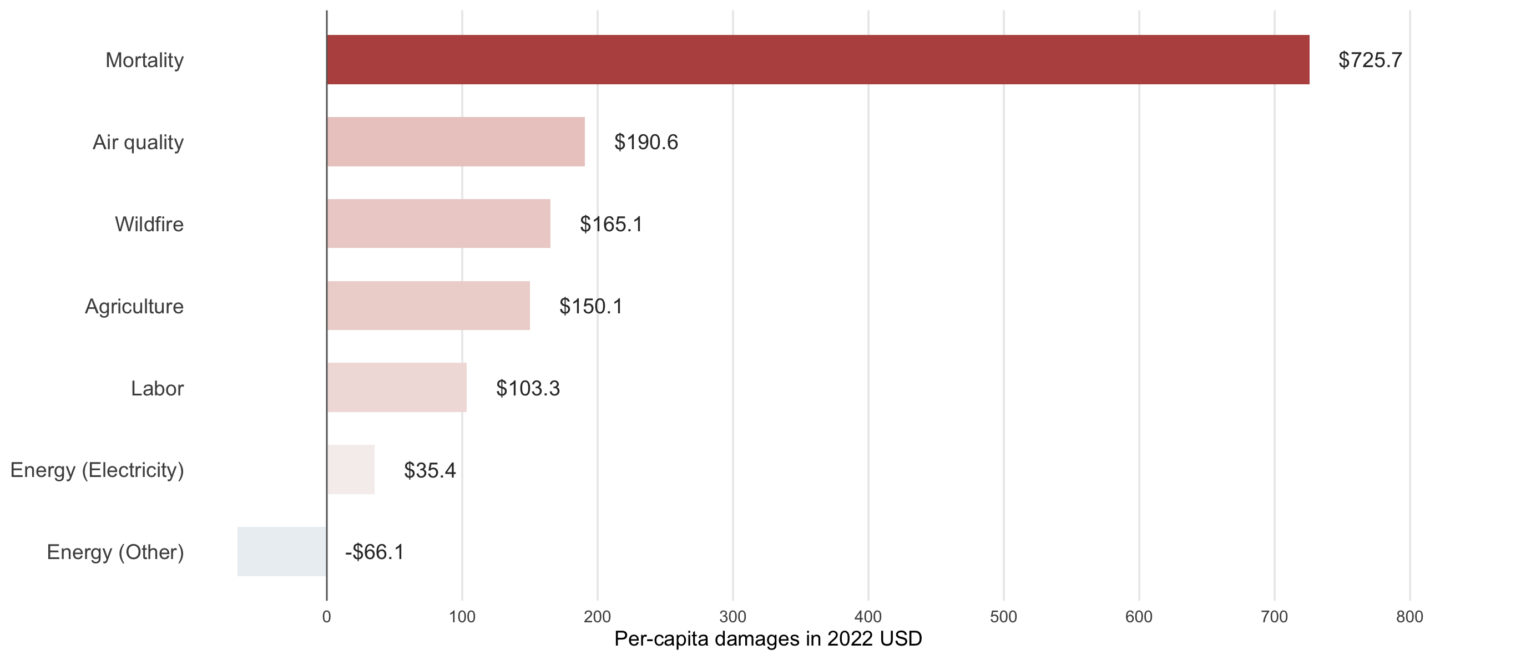
The following represent estimated California-specific per-capita impacts of climate change in 2100 under 3°F of warming. Note that these damages do not account for cross-sector interactions, do not quantify uncertainty, and do not include all sectors affected by climate change. Estimates are based on the US Environmental Protection Agency’s Framework for Evaluating Damage and Impacts (FrEDI).

    • Mortality: Mortality is the largest contributor to projected economic climate damages in California, with per capita losses from extreme heat alone estimated at $725.7. Because economic valuations of mortality rely on the value of a statistical life (VSL), even relatively small changes in mortality risk can translate into large estimated economic damages when applied across large populations. VSL estimates are periodically updated to account for inflation, income growth, and evolving empirical evidence. The 2026 VSL, as estimated by the U.S. Department of Health and Human Services, is approximately $13.7 million.

    • Air Quality: The $190.6 per capita damage estimate for air quality reflects the economic valuation of additional deaths caused by climate change-induced worsening of ozone and fine particulate matter, as both cause respiratory and cardiovascular disease and premature mortality.
    • Wildfire: The $ 165.1-per-capita damage estimate for wildfires reflects economic losses from both property destruction and smoke-related impacts on earnings.

    • Labor: The $103.3 per-capita labor damages reflect projected losses from heat-driven reductions in time worked and wages among heat-exposed occupations.

    • Agriculture: The $150.1 per-capita agricultural damage reflects projected losses from reduced yields of major staple crops (cotton, maize, soybeans, wheat) under warming. However, because California’s agricultural economy is dominated by higher-value specialty crops, this figure likely understates total climate-related agricultural losses.

    • Energy: While milder winters may reduce natural gas heating costs by $66.1 per capita, increased cooling demand may raise electricity costs by $35.4 per capita.

Bar chart showing per-capita damages by 2100 to show the scale of impact across different sectors under a 3°F temperature rise.

The damage functions were derived from both FrEDI and the Fifth National Climate Assessment, Chapter 19.

Mortality

$725.7 per capita

Wildfire

$165.1 per capita

Labor

$103.3 per capita

Implications for Households & Government

    • Property & Insurance: By 2050, sea-level rise could cause nearly $17.9 billion in damages to residential and commercial buildings.

    • Insurance Transformation: The California FAIR Plan’s exposure soared to $724 billion as of December 2025, a massive increase from $50 billion in 2018.

    • State Budgets: Wildfire protection spending has nearly quadrupled since 2005, reaching $2.9 billion in recent fiscal years.

    • Food Security:  Climate change is expected to increase national food price inflation by 1.5–2 percentage points annually by 2035.

Authorship & Timeline


  1. Paci, et al. (2023). The Economic, Fiscal, and Environmental Costs of Wildfires in California. Gordon & Betty Moore Foundation.

  2. U.S. EPA (2023). Technical Documentation for the Framework for Evaluating Damages and Impacts (FrEDI).

  3. Heutel, et al. (2021). Adaptation and the Mortality Effects of Temperature Across U.S. Climate Regions. The Review of Economics & Statistics.

  4. Munich Reinsurance Company (2025). Natural disaster figures for the first half of 2025.

  5. Medellín-Azuara et al. (2022). Economic Impacts of the 2020–22 Drought on California Agriculture. UC Merced.

  6. First Street Foundation (2021). The Cost of Climate: America’s growing flood risk.

  7. HHS. (2025). HHS Standard Values for Regulatory Analysis, 2025. Office of the Assistant Secretary for Planning and Evaluation.

  8. Hsiang et al. (2023). Fifth National Climate Assessment (Chapter 19: Economy). U.S. Global Change Research. Program. https://toolkit.climate.gov/NCA5

  9. Public Policy Institute of California (2024). Sea level rise in California.

  10. California FAIR Plan Association. (2026) Key statistics & data.

  11. Morales, et al. (2022). Climate Change Impacts Across California: Housing. California’s Legislative Analyst’s Office.

  12. Kotz, et al. (2024). Global warming and heat extremes increase food price inflation. Nature Climate Change.